Clothing & Accoutrements
  Men's Clothing in the 2nd Albany County Militia
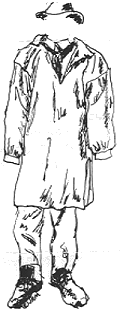
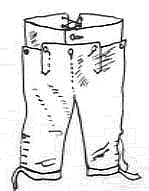
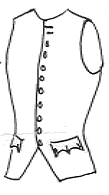
| First year: shirt, breeches or trousers, frock, plain hat, black tie shoes. Read this BEFORE buying anything. | Linen shirt, coat, reproduction shoes, overstitch machine stitches by hand. | (Where we would all like to be) All handsewn clothes. Handwoven fabric, i.e. linsey-woolsey and leather breeches. |
Women's Clothing in the 2nd Albany County Militia In the 2nd Regiment of the Albany County Militia, we are portraying middle and working class people of primarily Dutch and German decent. The Hudson Valley was settled by the Dutch in the 17th cen. About 1712 there was an influx of Palatine German refugees. After the French & Indian War some Scots and Irish came to the area. Think about what sort of person you want to portray - a well-to-do Dutch farm wife, a working class farm wife, a destitute war widow, a bound servant? It saves you cash in the long run to think about your persona first and then get clothing appropriate to the station you want to portray. This pamphlet will give you a basic introduction to 18c women's clothes. Many members will be glad to go into specifics such as ethnic details.
The basic underwear of all 18c women was a linen shift. This was something like a nightgown and covered her from neck to below the knee. It was a washable liner for her outer clothes. Sometimes it had a small ruffle at the neck and cuffs, but did not show much above the neckline. It is not difficult to sew. The rest of the underwear is a pair of long stockings, held up by tie-on garters. Blue stockings were common.
Over her shift she wore an under-petticoat, perhaps several depending on the season. The petticoats were linen or wool and tied around the waist. These did not have sewn in pockets. To keep her personal gear handy, she tied a, or, a pair of bag like pockets around her waist. These were about 20 inches long and 10 to 12" wide with a slit in the front. These could be plain white, embroidered or sewn out of pretty scrap fabric.
In the 18c, fashion decreed that the torso have a cone-like shape. To achieve this shape and support the breasts and back, a woman wore a set of strapless stays. Not as tight as later corsets, stays were made of linen canvass and stiffened with wood or whalebone. They laced up the back. Since these are rather expensive and need custom fitting, everyone has to decide for herself if and when to get some. Patterns and kits are available to make them but they are not a beginner's project.
Over the shift and under petticoats, she wore her top petticoat. This comes to a few inches above the ankle for working women and below the ankle for fine ladies. It tied around the waist, but beginners find a simple drawstring easier. These were sewn from linen or wool and were often striped. There is documentation that women near Albany wore black and blue striped petticoats and flowered jackets.*
Her top garment would be either a long gown (dress) or short gown or jacket. All of these go on like a coat and fasten in the front. By the 1770's the gown bodice met in the front, but some older women still wore the older style of lapel-like robings and a triangular filler called a stomacher. The older style is correct for F&I events. Little girls wore gowns that fastened in the back until puberty, then they dressed like their mothers.
Women doing heavy housework or farm work might wear a jacket or loose garment called a bed gown. There were also fitted jackets, short gowns, or a long jacket, sometimes called a curaco jacket. These were very fashionable and could pin shut or had hooks and eyes. Riding habit jackets were also worn.
To keep her clothes clean while working, she wore an apron. These were often checked, sometimes blue or unbleached linen. Less often they wore white or black aprons. Working class English women often wore dark blue aprons. Fashionable ladies might have embroidered or fine lawn aprons.
To protect her self from sunburn and for modesty, a woman wore a large (about 36") square kerchief around her neck, pinned, or tucked into her gown. This was usually white or checked linen or silk.
On her hair, she wore a white linen cap, often with a ribbon around it. There are several styles of caps: English, Dutch, and German. Caps got bigger as the century advanced. When she went out she put a hat on over the cap. This could be a flat wool or straw hat, or a silk bonnet. Black silk was the most commonly seen color bonnet, but some bonnets were brown, blue or dark green. Don't bother with the drawstring cap that is sold as a mobcap. There is no documentation for it. There are many cap patterns and sutlers sell quite a variety.
In bad weather, the 18c woman tied a hip-length wool cloak over her gown. The most common color was red, but they were also brown, blue and grey.
WHERE TO GET THE CLOTHES: Everything described above, except the stockings and hats can be sewn at home, or at the guild. There are a number of good patterns available on-line and at events. An excellent one for beginners is the JP Ryan Basic Six Piece Wardrobe. Always use 100% natural fiber! This means linen, cotton, wool, linsey-woolsey and linen/cotton blends. No polyester! Artificial fabrics are not flame repellant and will give you a bad burn. Stick to solid colors and woven stripes to begin with. Striped linen is now very commonly found on-line. Eventually you can develop an eye for 18c prints. PLEASE do not buy the sleeveless bodice sold by some sutlers; it is incorrect as an outer layer.
We are trying to re-create the life, look and feel of the 18th century as closely as we can. This means leaving modern accessories at home. Please avoid modern jewelry (except wedding rings), wristwatches, nail polish and makeup. However, sunscreen is always a good idea!
Shoes and glasses: Plain black flats or tie shoes are fine for your first year. Since shoes cost more, we don't require period shoes for the first year. It can also be a good idea to try on different brands and sizes at an event. Reproduction glasses frames can be purchased from sutlers. Optometrists should be able to put your own prescription in them. Please try to get period frames by the second year. We understand that can be difficult with some prescriptions and may take longer.
We hope you enjoy your living history experience! If you have any questions about what patterns or accessories to buy, feel free to ask. That is what the Yahoo group is for. Those of us who have been reenacting for a long time have closets full of stuff we thought was correct when we bought it! We want to save you from wasting your hard earned cash, so ask first if something is historically accurate.
Recommended patterns and books:
Also look at: http://www.memorialhall.mass.edu/activities/dressup/1770_woman.html
Copyright Second Reg., Albany County Militia 2009
*De la Tour du Pin, Henriette “...."One action of mine had won me immediate popularity. On the day I moved to the farm I adopted the dress worn by the women on the neighboring farms. The blue and black striped, woolen skirt (p'coat) the little bodice of dark calico and a colored kerchief
A refugee from the French Revolution, Mme. De la Tour became a farm wife, on Elisha's Kill, in what is now Latham on Rt. 155.